
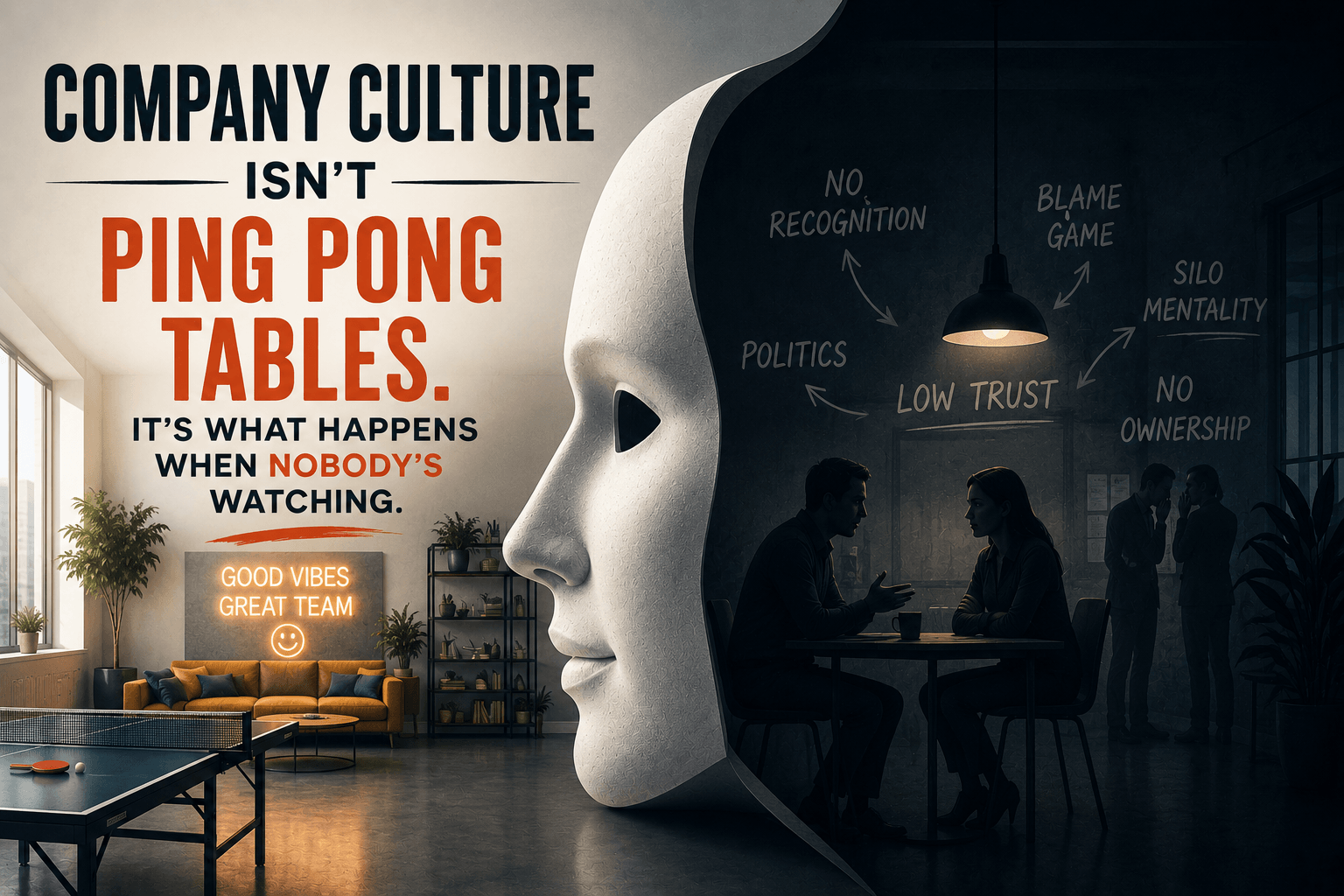
Stop Buying Perks and Start Building Real Culture
Walk into any startup office in 2026 and you’ll see the same things:
Bean bags. Ping pong tables. Free snacks. Colorful walls with motivational quotes. A “game room” nobody uses. Instagram-worthy spaces.
Then walk out and talk to the employees. You’ll hear different stories:
“Our culture is toxic, but hey, we have free coffee.” “Management doesn’t listen, but look, bean bags!” “People quit every month, but we have pizza Fridays!”
Here’s the uncomfortable truth: Company culture has nothing to do with office perks.
Real company culture is what happens when the boss isn’t looking. It’s how decisions are made in conference rooms. It’s whether people feel safe admitting mistakes. It’s if promises made are promises kept.
Let me show you what real company culture looks like—and it’s not what you think.
The Great Culture Scam
Somewhere around 2010, startups confused perks with culture. Tech companies started competing on office amenities, and everyone copied them.
The logic went: Google has a slide and free food → Google has great culture → Therefore, slides and free food = great culture
The reality: Google has a great culture because of how they hire, manage, communicate, and treat people. The slide is irrelevant.
What Companies Think Culture Is
❌ Ping pong tables and foosball
❌ Free snacks and catered lunches
❌ “Work hard, play hard” posters
❌ Team outings and parties
❌ Casual dress code
❌ Beer on Fridays
❌ Colorful office designs
❌ Company swag
❌ “We’re like a family” statements
These are perks or aesthetics. Not culture.
You can have all of these and still have a terrible culture.
What Culture Actually Is
✓ How decisions are made when the CEO isn’t in the room.
✓ Whether people feel safe admitting mistakes.
✓ If management actually listens or just pretends to.
✓ How conflicts get resolved (or buried).
✓ Whether promises made are promises kept.
✓ If credit is shared or hoarded.
✓ How people treat each other when stressed.
✓ Whether feedback flows both ways.
✓ If failure is learned from or punished.
✓ How transparent the company actually is
Culture is what happens when nobody’s performing for the boss.
The Journey From Fake to Real Culture
Most companies go through three phases:

Phase 1: The Perks Phase Buy gaming consoles, bean bags, free snacks. People use them initially, then stop. They’re not happier or more productive. The problem: treating symptoms, not causes. People don’t quit because of missing ping pong tables—they quit because they feel undervalued.
Phase 2: The “Values on Walls” Phase Create beautiful value statements. Put them everywhere. Reference them in meetings. But values on walls mean nothing if not lived in hallways. When companies miss deadlines, do they show “Customer First”? When mistakes happen, do they show “Collaboration”? Usually no. Values you don’t practice breed cynicism.
Phase 3: The Real Culture Phase Stop buying gimmicks. Start fixing actual problems:
- Transparency: Monthly open meetings sharing real numbers—revenue, challenges, wins, losses
- Safety: “What We Learned” sessions instead of blame meetings
- Feedback: Two-way conversations, not one-way reviews
- Recognition: Specific praise, not generic “great job” messages
- Promises: If you commit to something, deliver it or explain why not
The 7 Real Elements of Strong Company Culture
Here’s what culture really is:
1. Psychological Safety
Not: “We’re a family” (families have dysfunction too) But: “You can speak up, disagree, make mistakes, and admit confusion without fear”
How to build it:
- Leaders admit their own mistakes publicly
- Reward people who raise concerns early
- Zero tolerance for public shaming or blame games
- “Stupid questions” encouraged in meetings
Test: Does your newest junior employee feel comfortable disagreeing with the CEO in a meeting? If no, you don’t have psychological safety.
2. Transparent Communication
Not: Motivational all-hands where nothing is actually said But: Honest updates about company health, challenges, decisions, and why
How to build it:
- Monthly “State of Company” with real numbers
- Explain decisions, especially hard ones
- “I don’t know” is an acceptable answer
- Bad news shared quickly, not hidden
Test: Can any employee explain the company’s current biggest challenge and the plan to address it? If no, communication is failing.
3. Meritocracy That’s Actually Merit-Based
Not: “We promote based on performance” (then promote the CEO’s friend) But: Clear criteria for advancement, applied equally, with transparency
How to build it:
- Publish career ladder for each role
- Specific criteria for each level
- Regular calibration to ensure fairness
- Explain promotion decisions to those who ask
Test: Ask your team if they believe promotions are fair. If most say no, your meritocracy is performative.
4. Work-Life Integration
Not: Unlimited vacation that nobody takes because of peer pressure But: Actual respect for personal time and boundaries
How to build it:
- No messages expected after 7 PM or weekends
- Managers actively encourage time off
- Workload balanced so people can actually disconnect
- Flexible hours based on life needs, not office politics
Test: What percentage of your team took their full vacation last year? If under 80%, you have a culture problem.
5. Growth Opportunities
Not: “We invest in our people” posters But: Actual skill development, mentorship, and career progression
How to build it:
- Learning budget for each employee (courses, books, conferences)
- Mandatory mentorship for seniors
- Cross-training opportunities
- Clear growth paths with realistic timelines
Test: Ask employees what they’ve learned in the last 6 months and who helped them learn it. If they struggle to answer, growth is missing.
6. Ownership and Autonomy
Not: “We empower our team” (then micromanage everything) But: Real decision-making authority and trust
How to build it:
- Define outcomes, let teams decide how
- Stop requiring approval for every small decision
- Let people own projects end-to-end
- Support decisions even when you might have done differently
Test: Do people need approval for decisions within their role scope? If yes, you talk about autonomy but don’t practice it.
7. Values Lived, Not Displayed
Not: Beautiful value statements in conference rooms But: Every decision filtered through values, with accountability when violated
How to build it:
- When making decisions, explicitly reference which value guides it
- Call out when you violate your own values
- Reward people who uphold values even when inconvenient
- Use values in hiring, firing, promotion decisions
Test: Can employees cite examples of times the company sacrificed short-term gain to uphold a stated value? If no, values are decorative.
What Changes When You Fix Real Culture
Companies that shift from perks to real culture see dramatic improvements:
Employee Retention:
Turnover drops from 30-40% to 10-15% annually—massive savings in hiring and training costs.
Productivity:
Projects finish on time instead of running 15-20% over schedule. People focus on work, not office politics.
Innovation:
50-70% of improvements come from team (not just management) when people feel safe suggesting ideas.
Client Satisfaction:
Ratings jump from 7/10 to 8.5-9/10. Happy employees create happy clients.
Recruitment:
Applications increase significantly. Reputation spreads through word of mouth.
Revenue:
Consistent year-over-year growth. Culture becomes competitive advantage.
How to Build Real Culture (Action Plan)
Want to build genuine culture? Stop decorating and start fixing fundamentals.
Week 1-2: Audit Current Culture
Ask your team anonymously:
- Do you feel safe admitting mistakes?
- Do you trust management?
- Are you clear on how decisions are made?
- Do you feel heard?
- Can you see a future here?
- Would you recommend this as a workplace?
Don’t defend the answers. Just listen.

Week 3-4: Identify Top 3 Issues
From the feedback, what are the biggest problems? Usually:
- Lack of transparency
- Unclear growth paths
- Unfair recognition or promotion
- Poor work-life boundaries
- Management doesn’t listen
Pick the top 3. Not all of them. Three.
Month 2: Fix One Thing Completely
Not surface changes. Real fixes.
Example – If “lack of transparency” is top issue:
- Start monthly open meetings
- Share actual numbers (revenue, challenges)
- Explain major decisions and why
- Create channels for questions
- Commit to answering everything honestly
Example – If “unclear growth paths” is top issue:
- Document career ladder for each role
- Publish clear criteria for advancement
- Have career conversations quarterly
- Show examples of progression
- Explain why promotions happened
Month 3-4: Measure and Adjust
Did the issue improve? Survey again.
- If yes, tackle issue #2
- If no, dig deeper into why your fix didn’t work
Keep iterating until you fix it.
Month 5+: Build Systems That Scale Culture
Once you fix top issues, systematize them:
- Create onboarding that teaches real culture
- Build feedback loops (surveys, check-ins, retrospectives)
- Train managers on cultural values
- Make culture part of performance reviews
- Celebrate cultural wins publicly
What NOT to Do
Companies destroy their culture while trying to improve it. Avoid these:
Don’t: Copy another company’s culture
Why: Google’s culture works for Google. Not necessarily for you. Build culture that fits your business model, team, and values.
Don’t: Mandate “fun”
Why: Forced fun isn’t fun. It’s awkward performance art. Let organic connections happen.
Don’t: Ignore toxic high performers
Why: One toxic genius destroys culture faster than ten mediocre nice people build it. No exception for “rockstars.”
Don’t: Make values abstract
Why: “Innovation” means nothing. “We test new ideas and learn from failures” means something concrete people can act on.
Don’t: Talk about culture without fixing problems
Why: Words without action breed cynicism. Better to say nothing than make empty promises.
Don’t: Rush culture change
Why: Real culture takes 1-2 years to shift. Quick fixes fail. Be patient and consistent.
The Uncomfortable Questions You Need to Answer
Look at your company honestly and answer these:
1. If we removed all perks tomorrow, would people still want to work here? If no, you have perks, not culture.
2. Do people leave because they’re unhappy or because they got better offers? If unhappy, fix culture. If better offers, fix compensation.
3. Would our best employees recommend us to friends? If no, investigate why deeply. This is your reputation test.
4. Do exit interviews reveal patterns? If the same issues are repeated across multiple exits, you’re not listening or fixing.
5. Is our leadership team living the culture we claim? If no, culture is fake. Fix leadership first before expecting the team to change.
6. Can new employees see career progression examples? If no clear paths exist, growth is just talk.
7. When was the last time we acted on employee feedback? If you can’t remember, you’re collecting feedback but ignoring it.
The Truth About Culture ROI

CFOs ask: “What’s the ROI of culture investment?”
You can’t measure culture ROI directly. But you can measure its effects:
A strong culture reduces recruitment costs (people want to work there), lowers turnover costs (replacing employees costs 50-200% of annual salary), increases productivity (happy employees are 13% more productive), improves client retention, drives innovation, and builds reputation.
Conservative estimate: Strong culture saves 20-30% of annual salary costs in turnover alone. For a 50-person company, that’s significant savings annually.
Plus unmeasurable benefits: employee wellbeing, reputation, innovation capacity, resilience during crisis.
Real Culture Examples (What It Looks Like)
Example 1: Mistake Handling
Perks Culture: Developer breaks production. Management public shaming in Slack. The developer quits within 2 months.
Real Culture: Developer breaks production. Team debug together. Post-mortem focuses on “how do we prevent this system-wide?” The developer becomes an advocate for better testing practices.
Example 2: Promotion Decision
Perks Culture: CEO’s favorite gets promoted despite mediocre performance. Team morale tanks. Best performers start job hunting.
Real Culture: Promotion criteria are clear and public. When promotion happens, the announcement explains exactly why: “Raj mentored 3 juniors, led 2 successful projects, demonstrates leadership values.” Team sees it’s merit-based.
Example 3: Work-Life Boundary
Perks Culture: “Unlimited vacation” policy. CEO never takes time off. Employees feel guilty taking more than 10 days. Burnout increases.
Real Culture: Managers required to take at least 15 days off annually. When someone doesn’t take vacation, manager asks why and encourages it. Out-of-office is truly off—no messages expected.
Example 4: Feedback
Perks Culture: Annual performance review. One-way conversation. The employee has no voice. The process feels like judgment day.
Real Culture: Monthly check-ins. The manager asks “What can I do better?” as much as giving feedback. Conversation, not lecture. Continuous improvement, not annual surprise.
Example 5: Transparency
Perks Culture: Company struggling financially. Leadership hides it. Suddenly announces layoffs. Trust is destroyed forever.
Real Culture: Company struggling financially. Leadership shares challenges openly. Team brainstorms solutions together. Even if layoffs happen, transparency maintains trust.
The Bottom Line
Company culture isn’t:
- What you display in the office
- What you write on the website
- What you say in recruitment ads
- The perks you offer
Company culture is:
- How you treat people when it’s inconvenient
- Whether you keep promises when it costs you
- If feedback flows or gets blocked
- How you handle mistakes and conflicts
- Whether people trust leadership
- If values are lived or just displayed
You can’t buy real culture. You have to build it.
Stop investing in ping pong tables and start investing in:
- Trust through transparent communication
- Safety through non-punitive mistake handling
- Growth through real development opportunities
- Autonomy through actual decision-making authority
- Fairness through merit-based advancement
- Balance through respect for personal time
- Values through consistent action
Because the companies with real culture don’t need to advertise it.
People feel it, live it, and tell others about it.
And that’s the culture worth building.




Related Posts
Uncategorized
Uncategorized
Uncategorized